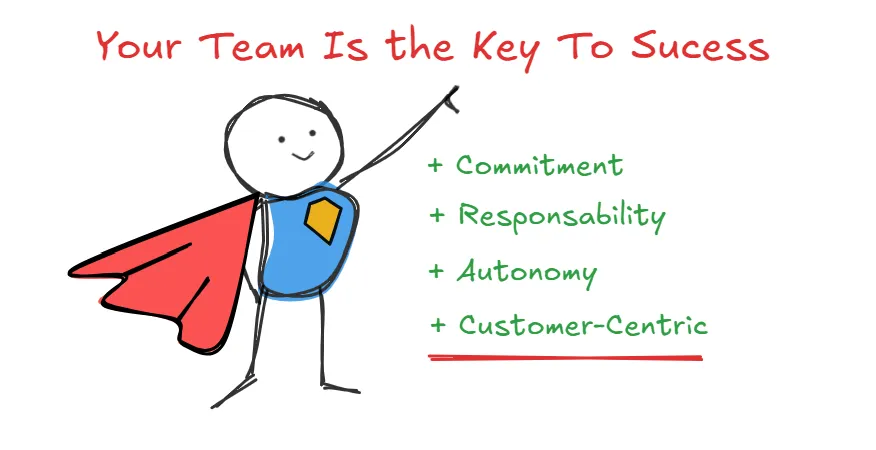
A good technical team is not just a group of people who can write code.
Code matters, of course. But the teams that consistently ship useful products tend to have something else: they understand the problem, they care about the outcome and they do not wait for every decision to be translated into a ticket.
After years building software as an employee, contractor, founder and technical lead, I keep seeing the same patterns.
Ownership
Ownership is the difference between finishing a task and protecting the result.
A person with ownership does not disappear after the pull request is merged. They ask whether the feature works in production, whether users understand it and whether the next problem is already visible.
Responsibility
Responsibility is less glamorous, but it keeps teams healthy.
People need to be able to trust each other. If something breaks, the team should know who is looking at it. If a deadline changes, people should hear it early. If a decision is unclear, someone should make the ambiguity visible.
That sounds simple. Many teams still fail there.
Autonomy
Autonomy does not mean everyone does whatever they want.
It means people have enough context to make good local decisions without waiting for permission on every detail. That requires trust, but it also requires clarity. The team needs to know what matters and what trade-offs are acceptable.
Customer proximity
The best engineers I have worked with were interested in the user problem, not only the implementation.
They wanted to know why something mattered, what the user was trying to do and where the current workflow was painful. That kind of curiosity changes the product. It also changes the quality of technical decisions.
Hard skills are the baseline. The real difference is whether the team can turn those skills into judgment.