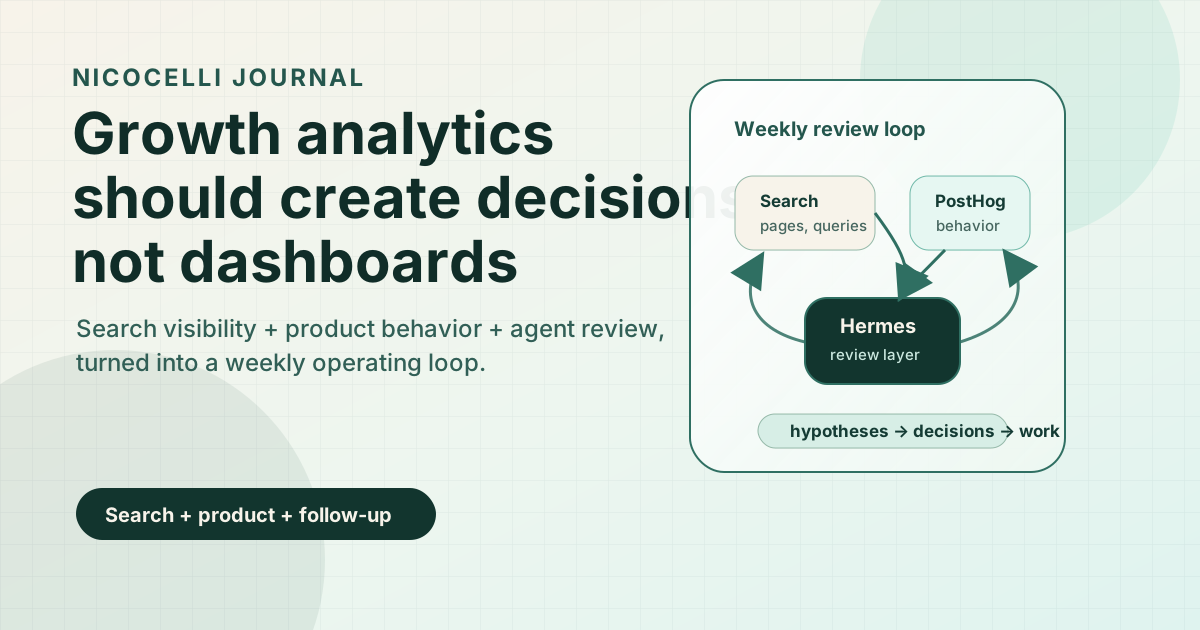
Most growth analytics work starts with a familiar ritual.
Open Google Search Console. Check queries, pages, clicks, impressions, ranking movement. Open PostHog. Check funnels, activation, recordings, errors, conversion paths, rage clicks, drop-offs. Then try to remember what changed last week, what was shipped, which page was edited, which experiment was running, and what still needs a decision.
The tools are not the problem. The gap is between seeing signals and turning them into work.
For IrishTalents, I care about this because acquisition and product behavior are not separate systems. A page can attract the right search demand and still fail if the next step is unclear. A signup flow can look fine in aggregate while a specific entry path creates friction. A content theme can look promising in Search Console but lead to visitors who never activate.
That is why I am more interested in a weekly operating loop than another dashboard.
The old problem is fragmented evidence
Search Console answers one side of the question: are people finding us?
PostHog answers another: what happens after they arrive?
Those are both useful. But the real operator question is usually more direct:
What should we improve next?
That question needs context from both sides. Search data without product behavior can lead to content that gets attention but does not help the business. Product analytics without acquisition context can improve a funnel while ignoring the pages and queries that bring the right people in.
Manual review works when the surface area is small. It breaks when the site, product, content library, and experiments keep changing. The work becomes too much collection and not enough judgment. I do not want to spend the first hour of review gathering screenshots and copying numbers before I can form a useful hypothesis.
I want the system to bring the evidence into one place, with enough discipline that I can trust the next step.
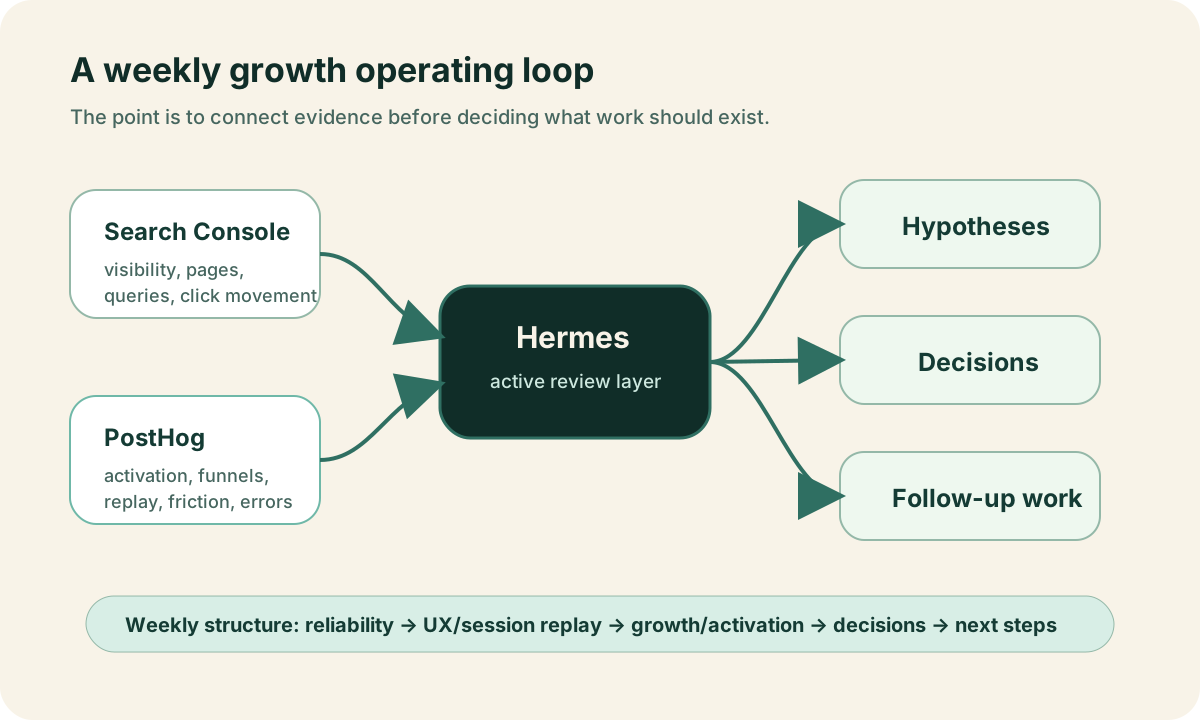
What each layer is responsible for
I think about the stack in three layers.
Google Search Console is the acquisition signal. It shows which queries and pages are gaining or losing visibility, which surfaces are getting impressions, where click-through may be weak, and where the site is being discovered in ways I did not expect.
PostHog is the behavior signal. It shows what visitors do after they arrive: onboarding, activation, conversion paths, exceptions, session replay patterns, weak CTAs, and product friction.
Hermes is the review layer. It should not pretend to know the answer by itself. Its job is to retrieve the right context, compare the signals, notice suspicious changes, write a concise report, and create follow-up work when the evidence is strong enough.
That last part matters. A useful agent loop does not end with a summary. It ends with a decision point.
Sometimes the decision is to inspect a landing page. Sometimes it is to rewrite a CTA. Sometimes it is to look at a session replay cluster. Sometimes it is to create a product issue because users are arriving with intent but failing inside the flow. Sometimes it is to do nothing because the signal is noisy or too early.
That is still progress. Saying “not enough evidence yet” is better than forcing a fake action item.
Active review beats passive reporting
The weekly loop I want is simple.
First, review search visibility and landing-page movement. Which pages changed? Which queries are emerging? Which pages are getting impressions but not clicks? Which content themes look stronger or weaker than last week?
Second, review product behavior after entry. Do those visitors sign up, explore, return, or disappear? Are they hitting broken flows, unclear forms, slow pages, missing states, or weak next steps?
Third, inspect reliability and UX friction. Exceptions, rage clicks, repeated navigation loops, and dead-end sessions are growth signals too. They are not just engineering hygiene.
Fourth, generate hypotheses. Not conclusions. Hypotheses.
A hypothesis might be: this page is attracting the right search demand, but the first CTA is too soft. Or: this query cluster is growing, but the landing page does not answer the user’s actual question. Or: activation dropped after a UI change, and the replay patterns suggest confusion around one step.
Fifth, decide what work should exist. A report is useful only if it creates a clearer next action: a content edit, a product fix, an SEO experiment, a tracking question, or a deliberate decision to wait.
For a SaaS product, this is where growth becomes less abstract. Acquisition, activation, conversion, retention signals, product friction, site reliability, and content-market fit are connected. Reviewing them separately makes the work feel cleaner than it really is.
How this changes SEO and GEO work
The lazy version of SEO is: publish more pages.
Sometimes that is the right move. Often it is not the first move.
A better operating loop asks different questions:
- Which pages attract the right visitors?
- Which pages lead to product activation?
- Which search surfaces need clearer CTAs?
- Which content themes should be expanded, improved, merged, or retired?
- Which pages have hidden UX or reliability problems after the click?
This matters even more as search behavior changes. Whether the traffic comes through classic search, AI-generated answers, branded queries, long-tail pages, or comparison research, the same discipline applies: attention is not the end of the system.
The page has to help someone do the next useful thing.
That is why I do not want SEO, GEO-style discovery, product analytics, and UX review to live in separate mental tabs. By GEO, I mean the practical work of making a site understandable and useful in AI-assisted search and answer surfaces, not chasing a new acronym for its own sake. The site is one operating surface. The review process should treat it that way.
The privacy boundary is part of the design
There is a version of this workflow that would be irresponsible: dump raw analytics exports, user sessions, candidate data, dashboards, or private commercial context into a prompt and ask an agent what to do.
That is not what I want.
The safer version is bounded. The agent can work with permitted summaries, aggregate signals, controlled tools, and explicit review rules. It can say what changed, what looks suspicious, and what should be inspected. It does not need raw private data to be useful.
For IrishTalents, that boundary is especially important. Public product lessons are fine. Private user-level data, credentials, session details, partner information, and sensitive strategy are not material for a blog post or an unbounded agent.
The system should make the boundary easier to maintain, not easier to ignore.
The output should be work, not theater
A weekly growth review should produce something concrete.
A short report. A few hypotheses. A list of decisions. One or two follow-up issues. Maybe a PR brief if the next step is already clear.
It should also preserve uncertainty. If the data is weak, stale, partial, or contradictory, the report should say so. Agents become dangerous when they turn thin evidence into confident recommendations.
The point is not to automate growth judgment. The point is to stop wasting human judgment on reassembling the same context every week.
I still want a person deciding what matters, what is worth testing, and what fits the product strategy. But I want that person to start from a prepared operating view: acquisition signal, behavior signal, reliability signal, hypotheses, decisions, next steps.
That is the shift I care about.
Not more dashboards.
A weekly loop that turns scattered growth data into reviewable work.