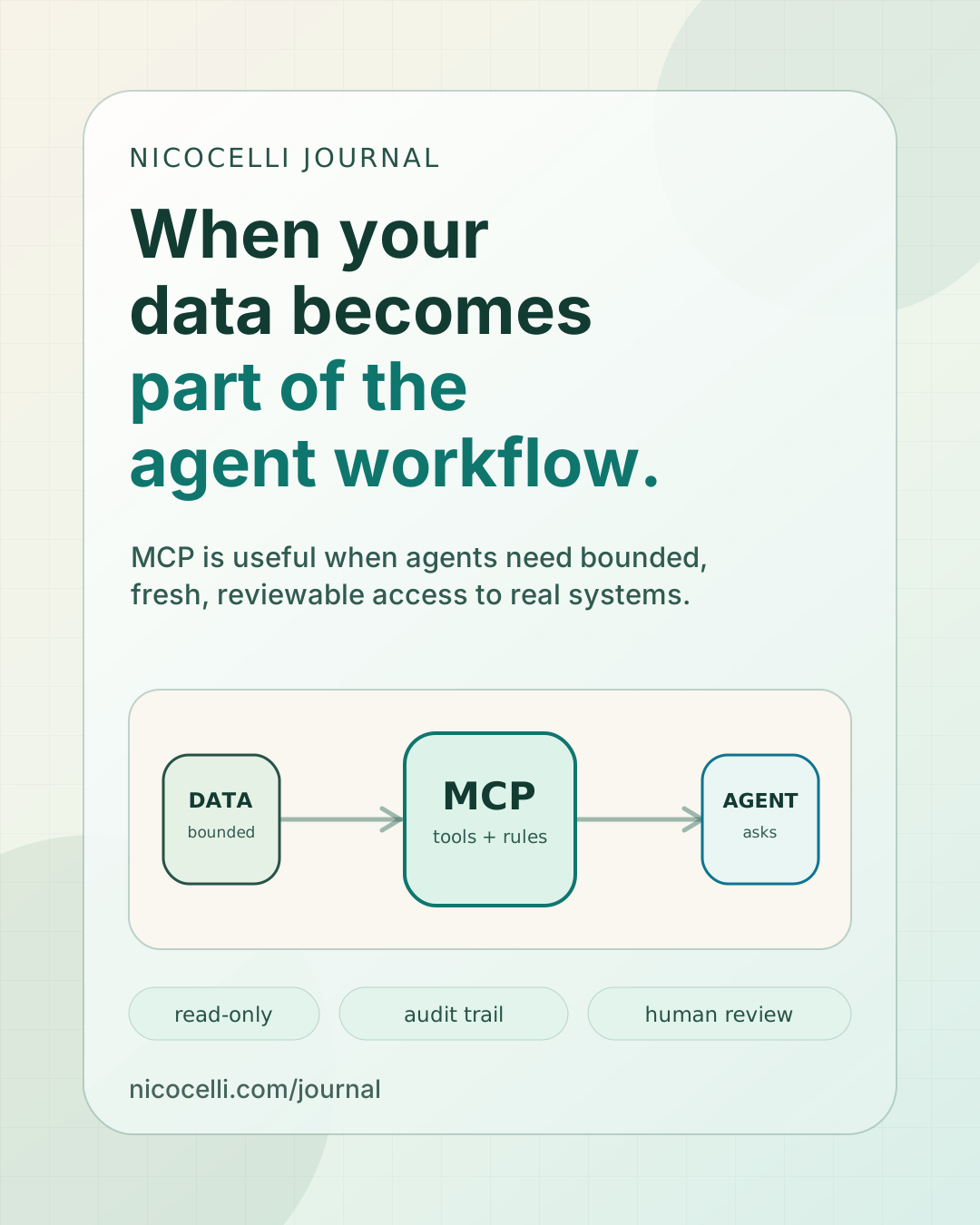
The moment an agent needs real data, the workflow changes.
A prompt is no longer enough. Copying a few numbers into a chat may work for a small question, but it breaks down when the answer depends on fresh data, permissions, data quality, or a system that changes every day.
That is the point where MCP starts to make sense to me.
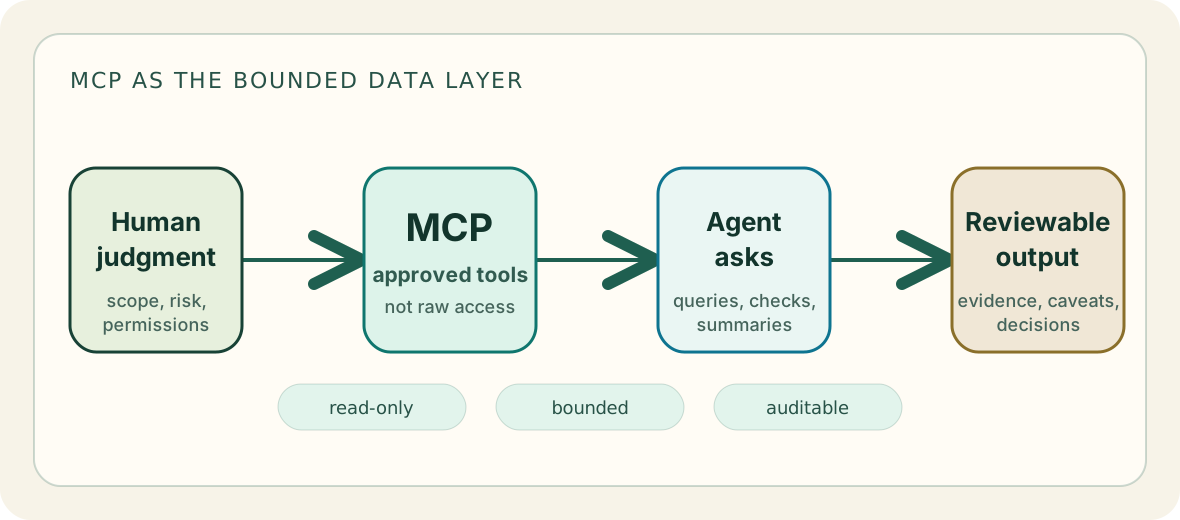
MCP, or Model Context Protocol, is a way to let an AI agent connect to tools and data sources through a defined interface. Instead of pasting context manually, the agent can ask approved tools for the information it needs. The important word is approved. The value is not that the model suddenly has access to everything. The value is that access can be bounded, repeatable, and reviewable.
I think about it less as an AI feature and more as infrastructure for agent work.
The problem with pasted context
Most agent workflows begin with manual context loading. You paste a brief. You paste a table. You paste logs. You paste a summary of what the system knows. Then the model reasons over that snapshot.
That can be useful. It is also fragile.
The snapshot may be stale. It may be incomplete. It may include details the agent did not need. It may miss the one field that changes the answer. And if you repeat the same question next week, you have to rebuild the context by hand again.
This is not only annoying. It changes the quality of the work. If an agent cannot inspect the underlying system, it starts guessing around the edges. Sometimes the guess sounds confident enough to become dangerous.
The better pattern is to let the agent ask the system directly, but only through the doors you intentionally open.
What MCP gives the agent
The simple version: MCP gives agents structured ways to use external context.
That context might be a database query, a document search, a product analytics summary, a repository lookup, a CRM record, a policy check, or a custom internal function. The agent does not need raw access to everything behind those systems. It needs the right questions exposed as tools.
For example:
- “summarize sponsor-company coverage by city”
- “check whether this document package is complete”
- “find records with missing industry classification”
- “return aggregate trends, not private rows”
- “compare this answer with the source fields used to produce it.”
That is a different relationship with data. The model is not carrying a huge pasted context window. It is calling constrained tools that can answer specific questions.
The product work is in deciding which questions deserve a tool, which answers need caveats, and which data should never be exposed to the agent at all.
Use case 1: market intelligence without raw exposure
IrishTalents is a good public-safe example of where this pattern matters.
At a high level, the product works around public market signals: companies, locations, sponsor-related information, roles, content, and coverage gaps. An agent could be useful in that environment, but only if the boundaries are clear.
I would not want an agent freely browsing raw private data or inventing claims from partial context. I would want bounded tools that answer product-level questions:
- Which sponsor-company records are missing city or industry fields?
- Which categories have enough coverage to support a content brief?
- What aggregate patterns are visible by city, industry, or role family?
- Which claims need official-source review before publication?
- Where is the data too thin to make a confident statement?
That last question matters. Good MCP tools should not only expose facts. They should expose uncertainty.
If an agent is helping with content strategy, SEO research, data-quality review, or product prioritization, it needs to know where the dataset is strong and where it is weak. Otherwise the agent may produce polished nonsense from an incomplete base.
The useful version is boring and governed: read-only tools, aggregate outputs, clear caveats, no candidate rows, no private partner details, no commercial strategy, no hidden dashboards leaking into public writing.
That is the difference between giving an agent data and giving it permission to help with the work.
Use case 2: financial workflows need stricter boundaries
A financial or credit evaluation workflow makes the boundary even more obvious.
Imagine a credit analyst or financial product team using agents to inspect structured borrower, transaction, risk, or document data. The agent could help find missing documents, summarize policy checks, flag affordability signals, or produce a portfolio-level view for human review.
But that does not mean the agent should make the decision.
In that kind of workflow, MCP-style tools would need to be precise. They might expose functions such as:
- document completeness checks
- borrower or portfolio summaries
- policy-rule comparisons
- risk-signal explanations
- audit trails showing which source fields were used.
The important part is governance. Permissions matter. Logs matter. Reproducibility matters. Human analysts still own final decisions, compliance, and judgment.
This is not a case for automated financial decisions hidden behind a friendly chat interface. It is a case for better tooling around review, context, and evidence.
When should you use MCP?
Use MCP when your data is important for agents.
More specifically, use it when agents need fresh or internal facts, when copying context manually is slow or unsafe, when tool access needs permissions, when outputs should be reproducible, or when the agent’s answer depends on data quality rather than language alone.
Do not use MCP just because it is the fashionable term. If a static document, a short prompt, or a small script solves the problem, keep it simple.
MCP becomes useful when the agent needs to ask the system, not invent the answer.
That is the line I keep coming back to. The more agent work moves from experiments into operating workflows, the more important that line becomes.
The product question behind the protocol
The technical implementation is only part of the work.
The harder product question is: what should the agent be allowed to know and do?
A good MCP layer should make those choices explicit. It should separate raw data from safe summaries. It should encode permissions. It should make uncertainty visible. It should leave logs and artifacts a person can review. It should help the agent produce better work without pretending the agent owns the decision.
That is why MCP interests me. Not because it makes agents feel more autonomous, but because it can make agent workflows more constrained, auditable, and useful.
The future I care about is not an agent with unlimited access.
It is an agent with the right access, the right tools, and a human still responsible for the consequences.